Blog
When Two Worlds Collide: Laoghaire, the High King at the Dawn of Christian Ireland

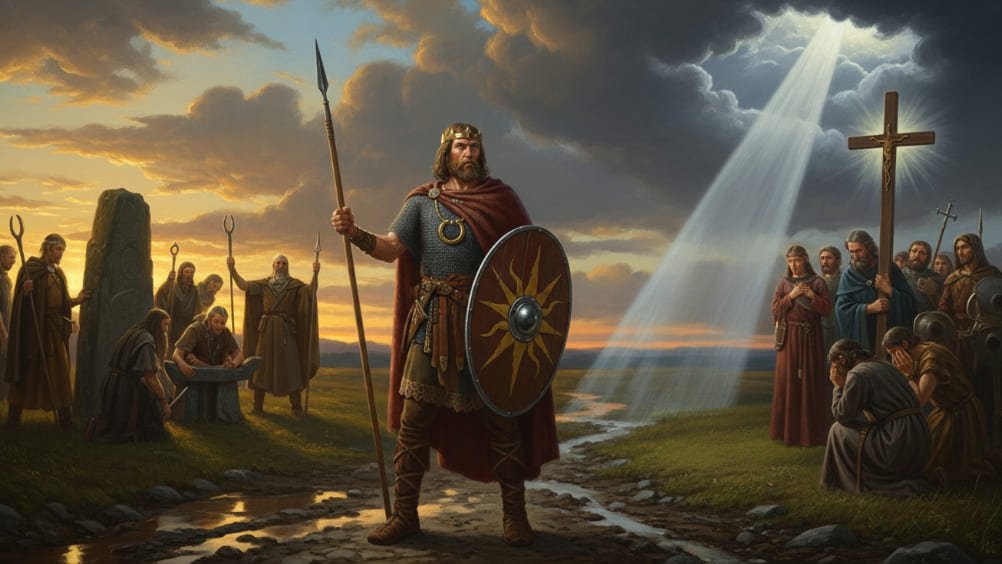
Imagine two fires burning against the darkness of an Irish spring night. One, a massive, roaring bonfire, is lit at the heart of the kingdom on the ancient, sacred Hill of Tara. The other, a smaller, defiant flame, flickers on the nearby Hill of Slane. Between these two fires stands a kingdom on the brink of irreversible change.
This is the central story of Lóegaire mac Néill (pronounced “Leary mac Nail”), the 5th-century High King of Ireland. He isn’t always remembered with the same romantic flair as warrior-kings or tragic heroes. Instead, Laoghaire is the man who stood at the threshold—the powerful embodiment of pagan, druidic Ireland at the exact moment Christianity arrived in the form of Saint Patrick.
The King on the Throne
To understand the drama, you have to understand the man and the place. Laoghaire was the son of the legendary Niall of the Nine Hostages, the founder of the powerful Uí Néill dynasty that would dominate Ireland for centuries. As High King (or Ard Rí), Laoghaire ruled from the Hill of Tara, the symbolic and spiritual center of the island. He was the head of a complex system of local kings, bound by oaths, tributes, and the powerful, ancient traditions enforced by his druid advisors.
In Laoghaire’s world, the king didn’t just rule; he was a guarantor of the cosmic order. His success meant good harvests, and his failures could bring plague or famine. This order was celebrated and renewed at great pagan festivals, the most important of which was Beltane (Bealtaine), which marked the beginning of summer.
The Defiant Flame
The story, as recorded centuries later in the Life of Patrick, is pure drama. It was the eve of Beltane. King Laoghaire had decreed that, as was tradition, no fire could be lit in the kingdom before the great pagan fire was kindled by his druids at Tara. This was a symbol of the king’s power and his control over the land.
Then, he saw it. A light, shining from the Hill of Slane, visible from Tara. Someone had defied the king’s most sacred edict.
The culprit, of course, was Saint Patrick, who had returned to Ireland as a bishop. Unbothered by the pagan king’s decree, he had lit the Paschal (Easter) fire, which that year coincided with the Beltane festival.
Laoghaire was furious. His druids, sensing a shift in the spiritual winds, reportedly gave him a chilling warning: “O King… the fire which we see… unless it be quenched this night, will never be quenched in Ériu [Ireland], but will overcome us all, and, rising, will overcome all the people of your kingdom.”
The Confrontation and the Stalemate
Laoghaire, his queen, and his warriors rode through the night to confront this upstart. What follows in the legends is a contest of wills and “magic” (or miracles). Patrick is said to have been summoned to Tara the next day, where he and his followers supposedly escaped an ambush by reciting the Lorica (the “Deer’s Cry”), a hymn that made them appear to their enemies as a herd of deer.
At Tara, Patrick directly challenged the druids in a contest of power. The legends speak of duels of miracles, of darkness and light. But the most important outcome wasn’t a clear-cut victory; it was a revolutionary stalemate.
Did King Laoghaire convert? The historical consensus is a firm “no.”
According to the accounts, Laoghaire was impressed—or at least intimidated—enough to grant Patrick a monumental concession: he would not harm him, and he would give him permission to preach his new faith throughout Ireland. He essentially told Patrick, “I will not convert, as my ancestors would not approve, but I will let you continue your work as long as you do not cause trouble.”
This was the crack in the door. The old power, embodied by Laoghaire, didn’t break, but it bent. It allowed the new faith to coexist, and in that coexistence, the new faith ultimately flourished.
The King’s End
Laoghaire’s legacy is that of this pivotal, complex moment. He remained a pagan—or at least, not a Christian—until his death. His end is as legendary as his confrontation with Patrick.
It’s said he was killed not in a great battle, but by the elements themselves. Having broken a sacred oath he swore “by the sun and the wind,” these forces of nature were said to have turned on him, striking him down. It was a fittingly pagan death for the last High King of a truly pagan Ireland.
Laoghaire isn’t remembered as a saint or a legendary warrior. He is something almost more important: a fulcrum. He is the historical figure who stood, confused and angry but ultimately pragmatic, at the very door of history as a new age walked in.